

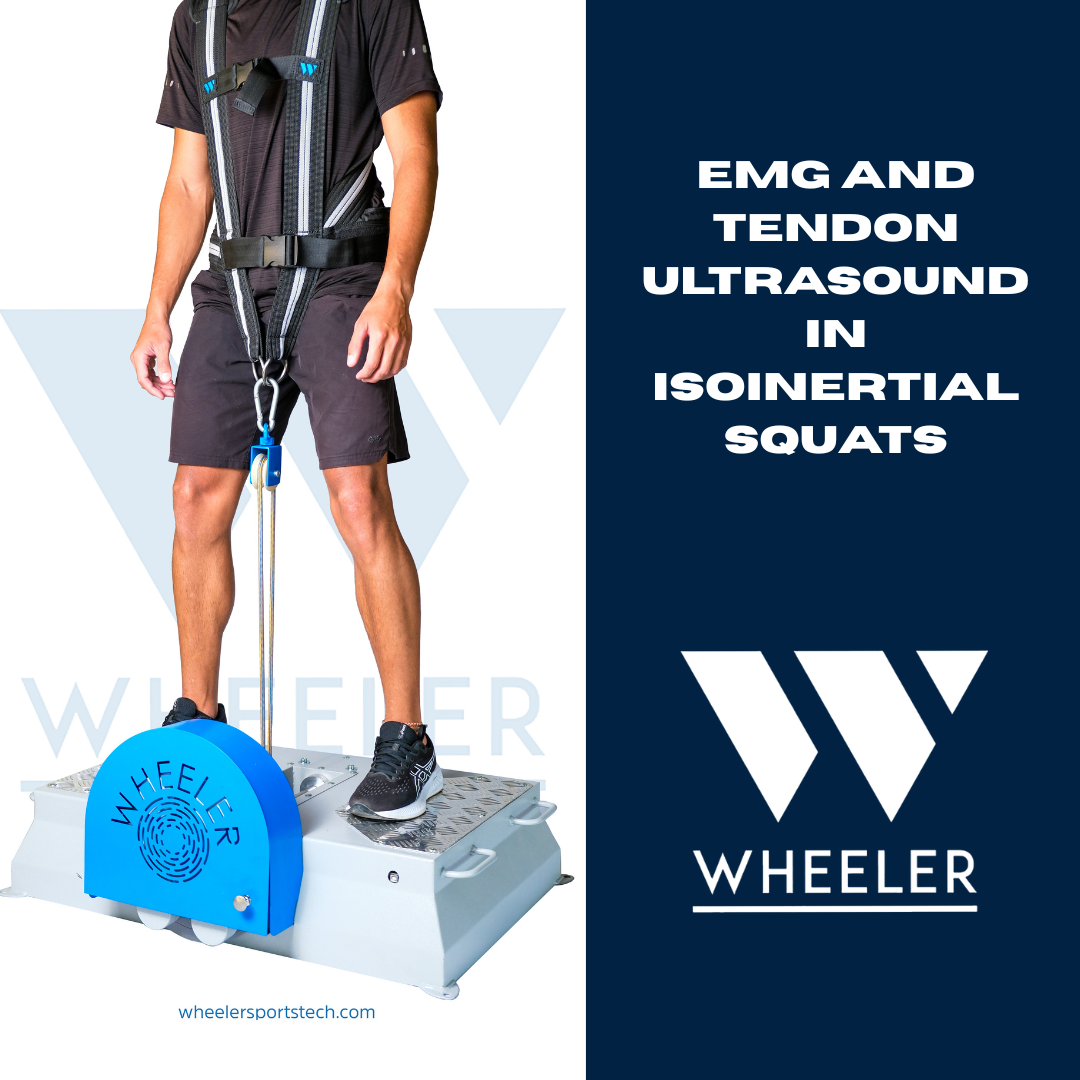
EMG and Tendon Ultrasound in Isoinertial Squats
Introduction: Why Combine EMG and Ultrasound in Isoinertial Training?
When training with isoinertial devices like the Wheeler YoYo, especially during high-tension movements like squats, it’s critical to understand both neuromuscular activation and tendon mechanical response. Two powerful tools for this purpose are:
- Electromyography (EMG) — which quantifies motor unit recruitment and muscle activation intensity, particularly during concentric and eccentric phases.
- Musculoskeletal ultrasound, including dynamic B-mode and elastography — which allows real-time visualization of tendon morphology, deformation, strain, and stiffness under load.
These tools are complementary: EMG shows how the nervous system is responding, while ultrasound shows how the tendon is behaving and adapting structurally during repeated high-load sets.
EMG During Isoinertial Squats: What It Shows
2.1 Eccentric Overload and Motor Activation
In an 8-rep set of Wheeler YoYo squats, the eccentric phase is actively overloaded by the inertia of the flywheel. The user must brake against the returning force, which modifies traditional EMG patterns:
- Studies on accentuated eccentric loading (AEL) show that eccentric EMG activation can surpass concentric levels, particularly in the vastus lateralis and rectus femoris.
- Research indicates increased rate of EMG activity during eccentric deceleration, especially at higher inertial loads. (sciencedirect.com)
This suggests that the YoYo squat demands greater neuromuscular control and co-contraction, especially during the eccentric braking phase.
2.2 EMG Findings in Isoinertial Training
Literature reports:
- Higher eccentric muscle activation (vs. traditional methods) in isoinertial squats, particularly in fast-twitch muscles and stabilizers.
- Specific EMG differences between vastus medialis, lateralis, and rectus femoris depending on technique and range of motion. (dspace.umh.es)
Such findings validate EMG as a real-time tool to measure neural demands across concentric/eccentric phases during sets like the 8-rep YoYo squat.
Tendon Ultrasound Tracking During and After YoYo Squat Sets
3.1 What Does Ultrasound Add?
Ultrasound imaging of tendons can quantify:
- Thickness and cross-sectional area (CSA)
- Real-time elongation and deformation during eccentric loading
- Echo patterns and fiber alignment
- Via elastography: local stiffness or strain in specific tendon regions (link.springer.com)
This is critical because tendons are dynamic mechanical structures. Under eccentric load, they undergo stretch, load transfer, and elastic recoil, all of which can now be observed and measured during movement.
3.2 Evidence from Eccentric Tendon Adaptation Studies
A recent study on eccentric squat protocols using YoYo devices found:
- After 6 weeks, there was a measurable increase in Achilles tendon CSA and changes in gastrocnemius pennation angle, indicating adaptation to repeated high-tension loads. (wheelersportstech.com)
- These adaptations were visualized and quantified via ultrasound, confirming structural change from eccentric overload.
While most studies use pre/post scans, real-time ultrasound during a set (e.g., 8 reps) allows us to observe instantaneous elongation and return of the tendon — its dynamic strain pattern — in correlation with each repetition’s load.
EMG + Ultrasound: Interpreting the Muscle-Tendon Behavior
4.1 Interpreting the Set Phases
A set of 8 reps on the Wheeler YoYo follows a pattern:
- Concentric push — high motor drive, high EMG, and initial tendon tension
- Eccentric braking — EMG increases to control the load, tendon elongates under braking force
- Tendon recoil — potential elastic recoil, visible via ultrasound as shortening or thickness change
By synchronizing EMG and ultrasound data, one can:
- Map motor activation peaks to tendon deformation peaks
- See if the tendon maintains elastic recoil capacity or begins to deform inefficiently
- Evaluate cumulative strain over repetitions, especially under fatigue
4.2 Functional Interpretation
In a well-executed YoYo squat series:
- High EMG during eccentric = strong neural engagement for control
- Ultrasound shows tendon deformation and recovery = effective elastic function
- No signs of pathological elongation or discontinuity = healthy adaptation
Together, this suggests an efficient muscle-tendon unit capable of force absorption and transmission under eccentric overload — ideal for performance and injury prevention.
Methodological Considerations and Limitations
5.1 Measurement Challenges
- Surface EMG is prone to noise and movement artifact, especially during dynamic lower-body work.
- Ultrasound tracking during squats requires a skilled operator and synchronized motion capture or robotic arm for precise tracking.
5.2 Research Gaps
- There are few studies applying real-time ultrasound + EMG during dynamic, high-intensity functional movements like YoYo squats.
- Most data comes from pre/post intervention comparisons, not in-set tracking of neuromuscular-tendon response. (link.springer.com)
6. Conclusion: A Multidimensional Window Into Eccentric Overload
Using:
EMG — to measure neural drive, recruitment, and co-activation
Ultrasound — to visualize tendon deformation, strain, and tissue integrity
…gives us a powerful, real-time window into how the neuromuscular and connective tissue systems respond during a loaded eccentric stimulus like the Wheeler YoYo squat.
This dual approach can:
- Assess mechanical demand and control
- Monitor tendon health and adaptation over time
- Guide individualized programming and injury prevention

Author