

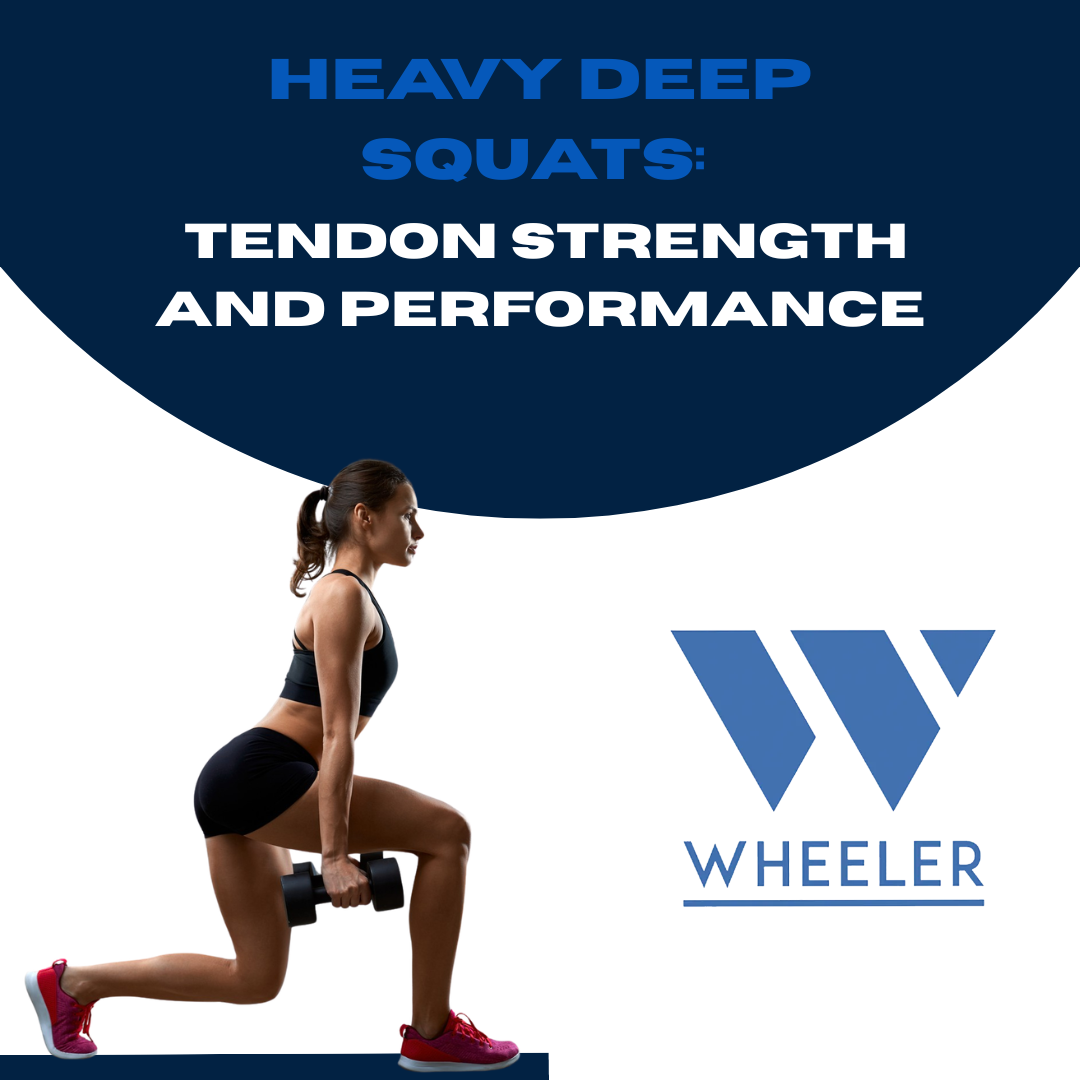
Heavy Deep Squats: Tendon Strength and Performance
Introduction – Why Focus on Tendons and Deep Squats
The heavy deep squat is a staple in strength and performance training due to its functional transfer to sports movements and its ability to develop lower-body strength, motor control, and joint stability.
However, beyond the muscular response, tendons are highly involved in this movement. Tendons (patellar, quadriceps, Achilles, etc.) are not passive structures; they adapt in stiffness, load tolerance, and energy transfer in response to repeated training stimuli.
Understanding how tendons respond to heavy deep squats is essential for designing safe and effective strength programs and for optimizing injury prevention and performance transfer.
Tendon Anatomy and Role in the Deep Squat Movement
2.1 Structural and Mechanical Function
Tendons connect muscle to bone and transmit the forces generated by the muscle. In the deep squat, the most involved tendons are:
- Patellar and quadriceps tendons – transmit force to extend the knee
- Achilles tendon and triceps surae complex – support ankle stabilization and contribute to knee/hip extension
- Glute and adductor tendons – stabilize the hip and control alignment in the sagittal and frontal planes
2.2 Mechanical Properties of Tendons
Tendons are non-linear viscoelastic structures, meaning they:
- Withstand high loads without immediate failure
- Store and release elastic energy
- Adapt their stiffness to chronic loading
These properties depend on fiber type, collagen orientation, and prior training load history.
What Happens to Tendons During Heavy Deep Squats?
3.1 Mechanical Tensions and Forces
In a deep squat under high load:
- Quadriceps and patellar tendons experience significant tension, especially between 90–120° knee flexion, due to increased moment arms
- Achilles tendon also supports substantial load to stabilize the ankle and transmit force to the ground
- Tendons undergo both tensile stress and stretch-shortening cycles during descent and ascent
This high mechanical load makes heavy deep squats a potent stimulus for tendon adaptation.
Tendon Adaptations to Heavy Deep Squat Training
4.1 Increased Tendon Stiffness
Tendon stiffness refers to resistance to deformation under load. A stiffer tendon can:
- Transmit force more efficiently
- Minimize energy loss during joint movement
- Enhance joint stability under high loads
Progressive, consistent exposure to heavy squats leads to increased stiffness due to collagen reorganization, increased tissue density, and improved muscle-tendon interface.
4.2 Structural and Biochemical Changes
Repetitive mechanical stress triggers:
- Increased synthesis of type I collagen
- Better collagen fiber alignment, enhancing load transfer
- Enhanced elastic energy storage and recoil, which can improve power output when combined with plyometrics
These adaptations require weeks to months of consistent loading to fully develop.
Functional Benefits of Tendon Adaptations from Heavy Deep Squats
5.1 Performance Transfer
Well-adapted tendons lead to:
- Improved total force production
- Enhanced explosive strength due to faster force transmission
- Greater joint stability for complex sports movements (jumps, cuts, changes of direction)
5.2 Neuromechanical Efficiency
Adapted tendons reduce:
- Delay in muscle-to-bone force transmission
- Energy leakage during eccentric movements
- Early onset of neuromuscular fatigue
This improves movement economy and resilience under competitive workloads.
Injury Prevention Implications
6.1 Load-Bearing Resilience
Tendons with adequate stiffness:
- Withstand force peaks more effectively
- Handle high training volumes with less microtrauma
- Are less prone to overuse injuries like tendinopathy
This is critical in sports where repetitive jumping, sprinting, or decelerations are frequent.
6.2 Improved Joint Control
Tendon adaptation also enhances:
- Passive and active joint stability
- Movement quality under load
- Protection against high-risk biomechanical patterns
This contributes to a safer joint environment in demanding situations.
Key Factors Modulating Tendon Response in Deep Squats
7.1 Depth of Squat
Going below parallel increases tendon stress, especially in the patellar and quadriceps tendons. This deeper position triggers greater mechanical adaptation—but also demands higher technique and mobility.
7.2 Absolute Load
Heavier weights create:
- Greater tendon stress
- Stronger long-term adaptation signals
But also require adequate recovery to avoid overtraining or tendinopathy.
7.3 Biomechanical Control
Execution quality (joint alignment, core stability, hip-knee-ankle posture) directly impacts how tendon load is distributed during the squat.
7.4 Tendon Training History
Tendons with prior injuries or low tissue quality may need:
- Slower progression
- Additional eccentric or isometric work
- Nutritional and recovery strategies to support remodeling
Practical Programming for Tendon Adaptation in Deep Squats
8.1 Load Principles
- Linear progression: Start with moderate loads, increase gradually
- Adequate volume: Sufficient for stimulus, but avoid excessive fatigue
- Recovery: At least 48–72 hours between heavy sessions for collagen remodeling
8.2 Weekly Microcycle Example
Day | Main Focus | Tendon Objective |
Monday | Heavy deep squat (4×5) | High tension for stiffness |
Tuesday | Core + mobility | Motor control + recovery |
Wednesday | Power/plyometrics | Elastic synergy |
Friday | Moderate squat (3×8) | Metabolic + technical load |
Sunday | Active recovery | Tissue regeneration |
8.3 Useful Variations
- Paused squats (eccentric focus) – increase time under tendon tension
- Unilateral squats (assisted) – enhance lateral stability and joint control
- Band-resisted squats – modify force curve and stimulate tendon recoil
Common Mistakes and Solutions
Mistake 1: Lifting Too Heavy Too Soon
Poor technique with high load = increased injury risk.
Fix: Prioritize movement quality before adding load.
Mistake 2: Inadequate Recovery
Tendons need longer recovery than muscles.
Fix: Respect rest days and include deload weeks.
Mistake 3: Ignoring Complementary Work
Heavy squats alone aren’t enough.
Fix: Combine with eccentric, core, and balance training.
Integration with Other Strength and Power Methods
10.1 Combine with Eccentric Work
Eccentric exercises (slow squats, Nordics) promote tendon remodeling and reinforce load tolerance.
10.2 Combine with Plyometrics
Plyometrics refine the elastic function of tendons post-heavy work, enhancing SSC efficiency and power.
Limitations and Precautions
- Tendon adaptation is slower than muscle growth – it takes time
- Response is individualized – age, genetics, training history matter
- Overuse or improper loading can lead to irritation or chronic tendon overload
Conclusion
The deep heavy squat is more than a muscle exercise—it’s a powerful tendon adaptation tool. When applied with:
✔ Proper technique
✔ Progressive loading
✔ Balanced recovery
…it promotes:
🔹 Increased tendon stiffness
🔹 Enhanced force transmission
🔹 Reduced injury risk
🔹 Better performance transfer to sport
As a strength and conditioning coach, understanding and leveraging tendon adaptations can elevate your athletes’ robustness, longevity, and readiness for high-intensity sports.

Author